Start with the AI your recruitment software already sells
Bullhorn holds its AI back for plans priced by quote, while Manatal includes AI scoring on every plan, so what you can buy off the shelf depends on the vendor. We're Logica HQ and we build custom AI agents for the jobs those plans don't cover, so our prices sit beside theirs below.
Bullhorn's UK price page shows the pattern. Its Starter plan is £80 a user a month and Core is £120, and neither lists an AI feature. AI search and match, CV formatting and call transcription sit on Pro, agentic screening on Max, and both are priced by quote.
Not every vendor holds AI back. Manatal includes AI candidate scoring and recommendations on every plan, from $15 a user a month billed annually. So the first question is what your current plan does, and what the next plan up would add. We only build what neither covers.
Six agency jobs AI can take on, and who should do each
| Job | Off the shelf | Built for you | Who decides |
|---|---|---|---|
| Parsing CVs into your CRM | Listed on Bullhorn's cheapest plan | Only for odd formats or a CRM with no parser | Nobody; it's data entry |
| Sorting a shared inbox of applications, client briefs and timesheets | Rarely offered across a whole mailbox | A triage agent that labels each email and files it | A consultant checks anything the agent isn't sure of |
| Matching candidates to a new role | AI search and match on higher plans | Matching against your own notes and past placements | A consultant picks the shortlist |
| Formatting CVs to your template | AI CV formatting listed on Bullhorn Pro | Rarely worth building | A consultant reads it before a client does |
| Chasing timesheets and references | Workflow tools and built-in automations | Worth it when the data sits in two systems | Rules you set, with exceptions to a person |
| Answering candidates out of hours | Chatbots on some plans | A chat or WhatsApp agent that knows your live roles | It hands over to a consultant |
Rejecting a candidate is missing from that table on purpose, and the rules below explain why; it's not a job we automate. The best early win is usually the inbox. Applications, client briefs and supplier mail land in one place, and someone reads all of it to find the few that need action today.
If your consultants start each day sorting a shared inbox, that's the job our inbox triage agents are built for. We've built the same pattern before: our mailbox-to-jobs tracker reads shared mailboxes, files enquiries, jobs and tenders onto a board, and sends anything uncertain to a person.
What UK law says about AI screening candidates
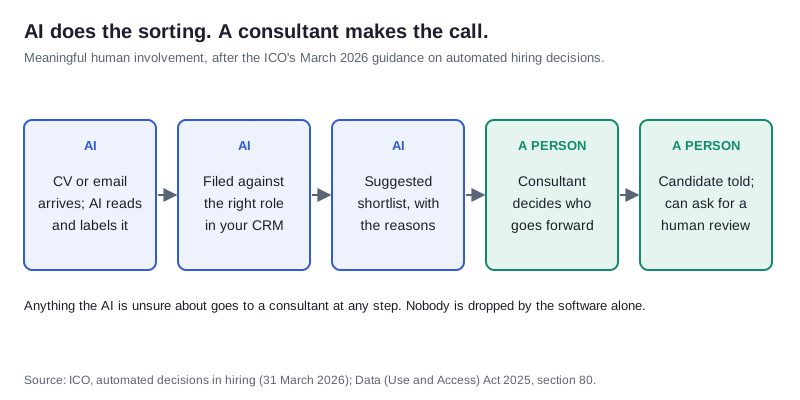
New rules on automated decisions came into force on 5 February 2026, under section 80 of the Data (Use and Access) Act 2025. The ICO's advice for employers says a decision is automated when there's "no meaningful human involvement" and it has a legal or similarly significant effect. If you make such decisions, you must tell candidates and explain how they work. You must also tell them how to challenge a decision and ask for a human review.
The ICO has looked at the tools too. In November 2024 it reported on audits of AI recruitment providers, where it made almost 300 recommendations. Some tools inferred gender and ethnicity from a candidate's name, and others collected far more personal information than they needed. The providers accepted or partially accepted all of the recommendations.
Section 55 of the Equality Act 2010 is the duty that applies to agencies as employment service-providers. Under the section, an employment service-provider must not discriminate in the arrangements for selecting who to provide its service to. The risk with software is real: the ICO's 2024 audits found tools that let recruiters filter out candidates with certain protected characteristics, so ask any tool you use what it filters on.
None of this stops you using AI to sort, rank or summarise. It means a consultant who can see the reasons, and overrule them, should make the call on who goes forward. That's how we build ours: the agent sorts and suggests, and a consultant decides. The government's Responsible AI in recruitment guide, published by DSIT in March 2024, sets out the checks to run before and after you buy.
What recruitment AI costs: published prices
| Option | Published price | What the price page lists | Limit |
|---|---|---|---|
| Bullhorn Starter or Core (UK) | £80 or £120 a user a month | Applicant tracking, CV parsing, client management; Core adds custom workflows | No AI features listed on either |
| Bullhorn Pro or Max (UK) | By quote | AI search and match, CV formatting, call transcription; Max adds agentic screening and a website chatbot | No published price |
| Manatal | From $15 a user a month billed annually, or $19 monthly | AI candidate scoring and recommendations on every plan | Priced in US dollars |
| Zapier, built by you | From $19.99 a month billed annually, for 750 tasks | Connects your tools with rules you set up | Someone in the agency builds and maintains it; priced in US dollars |
| A custom agent from Logica | From £1,450 for one task and one connected system; from £2,950 across 2 to 4 systems | Built around your inbox, CRM and rules, with a person signing off | We build on the software you already run; if you need a new recruitment CRM, buy one |
Each provider's own page, checked 9 November 2026. Bullhorn's page doesn't state VAT.
Two UK firms publish build prices in their own guides. SpotDev puts a custom agent at £8,000 to £45,000, after a £5,000 readiness assessment. Crox puts a project connecting AI to a CRM and inbox at £5,000 to £25,000. Ours are on the full price list, with AI usage passed through at cost.
A worked example: one shared inbox at a six-consultant agency
A six-consultant agency gets applications, client briefs, timesheets and supplier mail in one shared inbox. Its recruitment CRM already parses CVs. What it lacks is something that reads every email, files applications against the right role, flags new client briefs and leaves anything unclear for a person.
The agent
Triage of one mailbox is one task. Our inbox triage agent starts from £1,450, and a one-task agent goes live in one to three weeks.
If it grows
If applications should also update a timesheet or payroll system, the job spans more systems. That makes it a multi-step agent, from £2,950, live in four to ten weeks.
Running it
AI usage is passed through at cost with no markup. Support is optional and agreed before work starts.
The test
Set the build price against the hours your consultants spend sorting that inbox each week. If it's an hour a week, don't build it.
Who can build recruitment automation for you?
Your recruitment software vendor
Ask first. AI on a plan you'd move to anyway is usually cheaper than a build, and the vendor supports it.
You, with a workflow tool
Tools such as Zapier connect your inbox, CRM and spreadsheets with rules you set. It's cheap to start, but someone in the agency has to build it, fix it and keep it running.
A build firm
Worth it when the job spans systems no plan connects, or the AI has to work from your own notes and past placements. Ask for a fixed price and a written scope; our AI agent cost guide compares what firms publish.
A freelancer or contractor
Fine for a defined build, as long as you know who maintains it afterwards. Our guide to hiring a developer, contractor or agency weighs the routes.
Six questions the ICO says to ask before you buy
The ICO published six questions for anyone buying an AI recruitment tool. They apply just as well to a build:
- Have you completed a data protection impact assessment?
- What is your lawful basis for processing candidates' personal information?
- Have you documented who is responsible for what, and set clear processing instructions?
- Have you checked the provider has mitigated bias?
- Is the tool being used transparently, so candidates know?
- How will you limit processing to what you actually need?
Quick answers
Can AI reject candidates automatically?
AI can reject candidates automatically, but a solely automated decision like that now needs safeguards, including letting candidates ask for a human review. Most agencies are better off with a consultant making the call.
Do I need new recruitment software to use AI?
You don't need new recruitment software to use AI: check what your current plan offers, then connect or build around it. We build on the software you already run.
Does Bullhorn have AI features?
Bullhorn's AI features sit on its Pro and Max plans, priced by quote. Its UK price page lists AI search and match, CV formatting and call transcription on Pro, and agentic screening on Max, with none on Starter or Core.
How long does it take to build an AI agent for a recruitment agency?
An inbox triage agent for a recruitment agency goes live in one to three weeks with us, from £1,450. An agent that also updates a timesheet or payroll system spans more systems and takes four to ten weeks, from £2,950.